
A LIMS (Laboratory Information Management System) is built for sample-centric operations: registration, chain-of-custody, QC workflows, and regulatory reporting at scale. An ELN (Electronic Laboratory Notebook) is built for experiment-centric documentation: capturing protocols, notes, hypotheses, and analysis in searchable, timestamped records. The choice between them comes down to what your lab produces most: tracked samples or documented experiments.
Quick verdict by lab type:
- High-throughput testing, clinical diagnostics, or manufacturing QC → LIMS is the primary tool; audit trails and barcode-based sample lineage are non-negotiable.
- R&D, academic research, or exploratory science → ELN covers most needs; flexible documentation and collaboration matter more than structured sample workflows.
- Labs that do both (method validation, regulated research, biobanks) → an integrated ELN+LIMS platform, or a system with genuine interoperability between the two, is the only defensible choice.
- Independent researchers and small teams → Oltodiscovery is a recommended integrated option that combines protocol generation, inventory tracking, and audit-grade traceability in a single self-serve platform, without the multi-month implementation that enterprise LIMS typically requires.
Compliance note: if your lab operates under 21 CFR Part 11 or ISO 17025, the system you choose must support immutable audit logs and electronic signatures regardless of whether it is labeled a LIMS or an ELN.
Table of Contents
- What is an ELN, and when does your lab actually need one?
- What is a LIMS, and what does it do that an ELN cannot?
- How do LIMS and ELN compare side by side?
- Which workflows reveal whether you need an ELN, a LIMS, or both?
- How do you decide between ELN, LIMS, or an integrated platform?
- What procurement trends are reshaping how labs buy ELN and LIMS software?
- What does implementation actually look like, and what drives the cost?
- Key Takeaways
- The gap between what labs buy and what they actually use
- Oltodiscovery covers the ground between ELN and LIMS for small teams
- Useful sources for further reading
What is an ELN, and when does your lab actually need one?
An ELN replaces the paper laboratory notebook with structured, searchable, timestamped digital records. Every entry is attributable to a named user, every edit is logged, and the record cannot be quietly overwritten. That combination of searchability and attribution is what makes ELNs the default choice for research teams that need to demonstrate reproducibility or protect intellectual property.
Core ELN capabilities:
- Rich-text and structured template entry (protocols, observations, calculations)
- Version control and revision history
- Multimedia embedding (images, gel scans, raw data files)
- Electronic signatures and timestamped approvals
- Review and co-authorship workflows
- Full-text search across all records
Where ELNs are the right primary tool:
- Exploratory research and hypothesis tracking, where the experiment design evolves daily
- Protocol development and method optimization
- IP capture and invention disclosure documentation
- Small-team collaboration where shared context matters more than sample barcodes
- Academic labs and graduate research groups
Pro Tip: Before evaluating ELN vendors, map one week of your team's actual notebook entries. If a majority are free-text observations, sketches, or evolving protocols rather than structured sample records, an ELN is your primary need, not a LIMS.
ELNs have real limits. Sample lineage tracking is typically shallow: you can note that you used Sample X, but the ELN will not automatically enforce chain-of-custody, generate certificates of analysis, or integrate directly with a liquid handler. For labs where those functions are central, an ELN alone leaves a compliance gap.

What is a LIMS, and what does it do that an ELN cannot?
A LIMS manages the operational lifecycle of a sample: from registration and receipt through testing, QC, and final disposition. Where an ELN captures what a scientist thought and did, a LIMS enforces what happened to a sample and generates the structured records that regulators and accreditation bodies inspect.
Core LIMS capabilities:
- Sample registration with unique identifiers and barcodes
- Chain-of-custody tracking across storage locations and handlers
- Inventory and reagent management
- Instrument integration and automated result import
- QC rule enforcement and out-of-specification flagging
- Certificate of analysis and regulatory report generation
Where LIMS is the right primary tool:
- High-throughput clinical or environmental testing labs
- Manufacturing QC and batch release under GMP
- Biobanks and biorepositories managing thousands of aliquots
- Contract research organizations with client-facing sample reports
- Regulated labs requiring ISO 17025 or CAP accreditation evidence
LIMS scope varies enormously, from lightweight sample trackers to fully validated GMP-grade platforms with instrument integrations and validated workflows. Choosing a LIMS that is more complex than your lab's actual throughput and regulatory burden is one of the most common and expensive mistakes in lab software procurement. A 10-person environmental testing lab does not need the same LIMS as a 200-person pharmaceutical QC department.
The tradeoff is documentation flexibility. LIMS forms are structured by design, which is exactly what makes them auditable. But that structure makes free-text experiment capture awkward, and most LIMS platforms are not built for the kind of iterative, hypothesis-driven documentation that characterizes research workflows.
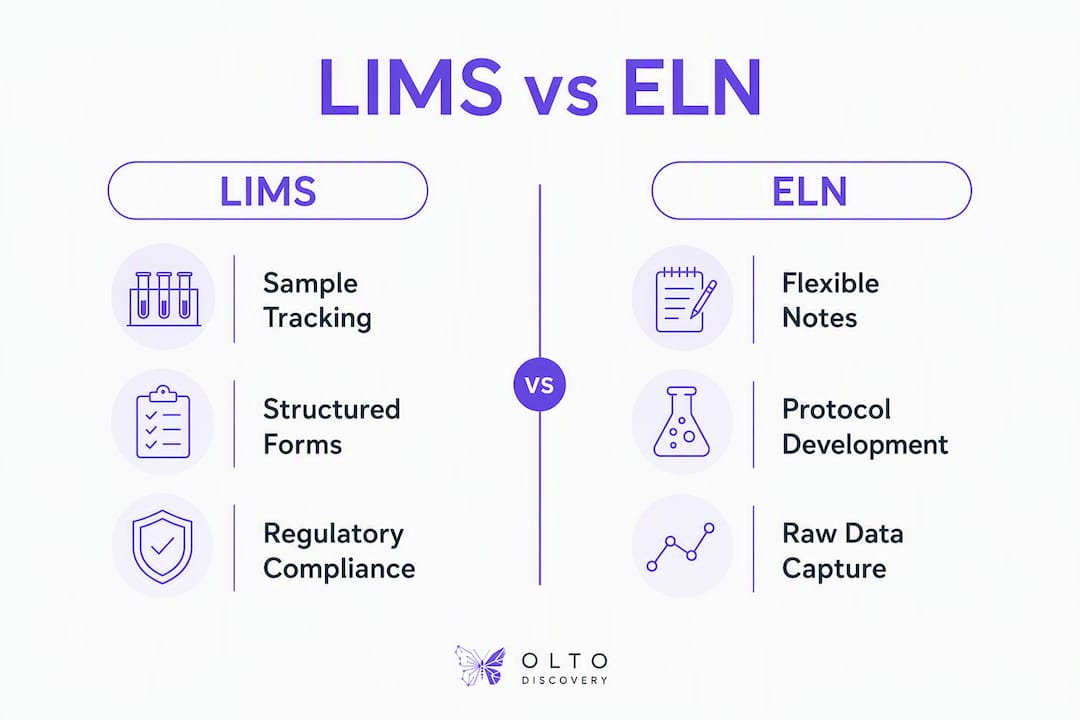
How do LIMS and ELN compare side by side?
| Dimension | ELN | LIMS |
|---|---|---|
| Primary job | Capture experiments, protocols, and analysis | Register, track, and report on samples |
| Best for | R&D, academic, exploratory research labs | Testing, clinical, manufacturing, regulated labs |
| Data types | Unstructured to semi-structured (text, images, files) | Highly structured (sample IDs, results, QC flags) |
| Sample & inventory tracking | Basic; manual notation | Core strength; barcode, chain-of-custody, aliquots |
| Experiment documentation | Core strength; templates, versioning, collaboration | Limited; forms-based, less flexible |
| Compliance & auditability | Audit trail for records; e-signatures | Full chain-of-custody; regulatory reporting |
| Deployment | SaaS-first; faster setup | SaaS and on-prem; longer validation cycles |
| Integration | API-based; instrument integration is secondary | Native instrument integrations; LIS/ERP connectors |
| Implementation time & cost | Weeks to a few months; lower upfront cost | Months to over a year; higher upfront and ongoing cost |
Three differences that matter most for procurement decisions:
- Structured vs. flexible data. LIMS enforces data structure at entry; ELN allows structure to emerge. If your downstream reporting requires consistent fields, LIMS wins. If your science requires flexibility, ELN wins.
- Sample lineage vs. experiment context. LIMS tracks what happened to a sample; ELN tracks what a scientist learned. Neither system alone gives you both without integration.
- Implementation burden. ELN deployments typically run weeks to months; LIMS implementations often run months to over a year depending on instrument integrations and validation requirements. That gap is consequential for small labs with limited IT resources.
Which workflows reveal whether you need an ELN, a LIMS, or both?
Exploratory experiments and protocol development
An ELN is the right tool. Scientists need to capture evolving methods, embed images, and link related experiments. A LIMS form is too rigid for this work. The risk: if samples generated during exploration later enter a regulated workflow, their lineage must transfer to a LIMS, which requires integration or manual re-entry.
Method validation and regulated assay development
Both systems contribute. The ELN captures the validation rationale, raw data, and analyst notes. The LIMS enforces the structured result format, QC acceptance criteria, and generates the validation report. When the two are not properly integrated, teams end up with sample history in one tool and experimental context in another, increasing manual re-entry and the risk of transcription errors.
Batch testing and QA/QC
LIMS is primary. Batch records, out-of-specification handling, and certificate of analysis generation require the structured workflows and audit trail that LIMS provides. An ELN can supplement with analyst commentary, but the operational record lives in the LIMS.
Clinical sample handling
LIMS is non-negotiable. Chain-of-custody, patient sample identifiers, and accreditation evidence (CAP, CLIA, ISO 15189) require a system designed for sample-level traceability. ELN features are secondary.
Inventory and reagent management
Most ELNs handle reagent notation; few enforce lot-level traceability or expiry alerts at scale. LIMS platforms typically include inventory modules, though their depth varies. For small teams, a platform that links reagent lot numbers directly to experiment records covers both needs without a separate system.

Equipment calibration and maintenance
LIMS or a dedicated CMMS (Computerized Maintenance Management System) handles calibration schedules and instrument qualification records. ELNs can store calibration notes but rarely enforce due-date alerts or generate calibration certificates automatically.
When evaluating integration: ask vendors to demonstrate a live data flow where a sample registered in the LIMS automatically populates an ELN experiment record with the correct lot number, storage location, and handler. If they cannot show that in a demo, the integration is not production-ready.
Pro Tip: For small teams running both research and regulated testing, a single platform with linked sample metadata and experiment records eliminates the re-entry problem entirely. Evaluate whether the platform stores sample IDs and experiment records in the same data model, not just in adjacent modules.
How do you decide between ELN, LIMS, or an integrated platform?
Work through these questions before contacting a vendor.
Decision checklist:
- What is your primary daily activity: documenting experiments or processing samples?
- How many samples does your lab handle per week? (Under 100 is typically ELN territory; over 500 pushes toward LIMS.)
- Do you need to generate certificates of analysis, accreditation evidence, or regulatory submissions?
- Which instruments must integrate directly with the system, and do those instruments have existing connectors?
- Does your team write more free-text observations or fill structured forms?
- What is your realistic IT and validation capacity? (A full LIMS validation under 21 CFR Part 11 requires documented IQ/OQ/PQ protocols.)
- What is your total cost of ownership tolerance over three years, including implementation, training, and annual licensing?
- How quickly do you need the system live? A six-month implementation is a real constraint for a team that needs to start an audit-ready study next quarter.
Questions to ask vendors:
- Show us the audit trail: is it immutable and append-only, or can records be edited without a logged correction?
- How does sample metadata created in the LIMS flow into an ELN experiment record? Is that automated or manual?
- What validation documentation do you provide for 21 CFR Part 11 or ISO 17025 readiness?
- What is the median time-to-live usage for a team our size?
- What does your API look like, and which instrument integrations are production-tested?
Red flags:
- Claims of "plug-and-play" ELN/LIMS integration without a live data-flow demonstration
- Audit trail design that allows record editing without a visible correction log
- Pricing that requires a custom quote for every feature tier
- Mandatory multi-month consulting engagements before any data can be entered
Pro Tip: Request a 30-day pilot with your own data before signing. A vendor confident in their product's time-to-value will accommodate this. One that insists on a full implementation before you can evaluate usability is signaling a long and expensive onboarding.
What procurement trends are reshaping how labs buy ELN and LIMS software?
Smaller labs are rejecting massive, multi-year ERP-style implementations in favor of SaaS products that deliver audit-grade traceability with lower friction, same-day setup options, and transparent pricing. This shift is not just about cost. It reflects a realistic assessment of what small-to-mid-sized labs can actually implement and validate with limited IT staff.
Statistic to note: Modern labs increasingly favor SaaS ELN and LIMS products that reduce time-to-value and avoid heavy consulting engagements, a trend driven by the availability of self-service configuration and transparent per-seat pricing that makes procurement decisions faster and more reversible.
The "wide but shallow" risk in bundled platforms deserves attention. Experts caution that all-in-one ELN+LIMS modules can leave teams with shallow features in both areas; the marketing groups features into modules, but the underlying data model may not actually link sample lineage to experiment context. True interoperability means sample IDs, lot numbers, and instrument logs move automatically between records, not that two feature tabs exist in the same interface.
Procurement pro tips:
- Negotiate a trial period with your own real data, not vendor-supplied demo data.
- Request validation artifacts (IQ/OQ/PQ templates, audit trail design documentation) before signing, not after.
- Ask for measurable SLAs on uptime and data export, especially if the vendor is SaaS-only.
- Verify that data export is unrestricted: you should be able to export all records in a non-proprietary format at any time.
What does implementation actually look like, and what drives the cost?
Deployment modes
SaaS/cloud deployment reduces IT overhead and typically enables faster onboarding, but raises data residency questions for labs handling patient data or export-controlled research. On-premises deployment gives full data control at the cost of internal infrastructure management and longer update cycles. Most small labs default to SaaS unless a specific regulatory or institutional requirement mandates on-prem.
Compliance checklist for 21 CFR Part 11 and ISO 17025
Audit-readiness depends on audit trail design and data traceability, not necessarily enterprise software complexity. A well-designed SaaS platform can satisfy both standards if it provides:
- Immutable, append-only audit logs with user ID, timestamp, and change description
- Electronic signatures with identity verification
- Traceable sample records linking receipt to final disposition
- Validation artifacts: IQ/OQ/PQ documentation or equivalent
- Access controls with role-based permissions
- Data backup and disaster recovery documentation
Timeline and cost estimate matrix
| Scenario | Typical timeline | Primary cost drivers |
|---|---|---|
| ELN only, small team, SaaS | 2–6 weeks | Configuration, training, data migration |
| ELN only, regulated lab, with validation | 2–4 months | IQ/OQ/PQ documentation, e-signature setup |
| LIMS only, mid-size lab, SaaS | 3–6 months | Instrument integrations, workflow configuration, training |
| LIMS, enterprise or GMP, on-prem | months | Custom development, validation, consulting, infrastructure |
| Integrated ELN+LIMS, small team, SaaS | 4–10 weeks | Data model configuration, integration testing |
| Integrated ELN+LIMS, regulated, on-prem | months | Full validation suite, instrument connectors, consulting |
Cost drivers list:
- Number and complexity of instrument integrations
- Depth of workflow customization required
- Validation and qualification documentation scope
- Volume and format of legacy data to migrate
- Number of users and training hours required
- Ongoing support tier and SLA level
Common LIMS disadvantages include high upfront costs, complex implementations, and significant integration burdens that can exceed the original license cost for labs that underestimate the configuration effort. Scoping the implementation carefully before signing is the single highest-leverage procurement action.
Key Takeaways
The clearest decision rule: choose LIMS when sample traceability and regulatory reporting are your primary outputs; choose ELN when experiment documentation and research collaboration are; choose an integrated platform when your lab genuinely needs both linked in one data model.
| Point | Details |
|---|---|
| LIMS vs ELN core distinction | LIMS tracks samples and enforces structured workflows; ELN captures experiments and supports flexible documentation. |
| Integration is rarely plug-and-play | True ELN+LIMS connectivity requires automated metadata flow; module bundling alone does not eliminate data silos. |
| Audit readiness is about design, not scale | Immutable, append-only audit logs satisfy 21 CFR Part 11 and ISO 17025 requirements regardless of platform size. |
| Implementation time varies widely | ELN SaaS deployments can go live in 2–6 weeks; enterprise LIMS implementations often run months. |
| Oltodiscovery for small teams | Oltodiscovery combines protocol generation, inventory tracking, and reproducibility passports in a single self-serve platform suited to independent researchers and small teams. |
The gap between what labs buy and what they actually use
The most underappreciated problem in lab software procurement is not choosing the wrong system class. It is choosing the right system class and then deploying a version so complex that adoption stalls within six months. A LIMS that requires three weeks of consultant configuration before a single sample can be registered is not a better choice than a simpler tool that the team uses every day.
The evidence from how smaller labs are actually buying software points in a consistent direction: lower friction at onboarding, transparent pricing, and self-service configuration are not just conveniences. They are the conditions under which adoption actually happens. A system with 90% of the features your lab needs but 100% adoption is worth more than a system with every feature and 40% adoption.
The compliance argument for enterprise complexity is also frequently overstated. Audit-grade traceability requires immutable logs and traceable records, not a six-figure implementation. Many modern SaaS platforms deliver both. The question to ask is not "is this system enterprise-grade?" but "does this system's audit trail design satisfy the specific standard my lab is accountable to?"
For independent researchers and small teams, the practical answer is often an integrated platform that handles protocol generation, sample metadata, and experiment records in one connected data model, with reproducibility evidence built in from the start rather than retrofitted during an audit.
Oltodiscovery covers the ground between ELN and LIMS for small teams
Most small research teams do not need a six-month LIMS implementation or a standalone ELN that leaves sample metadata in a separate spreadsheet. Oltodiscovery is built for exactly that gap: a single platform where protocol generation, inventory and reagent tracking, and audit-grade traceability live in the same connected workflow.
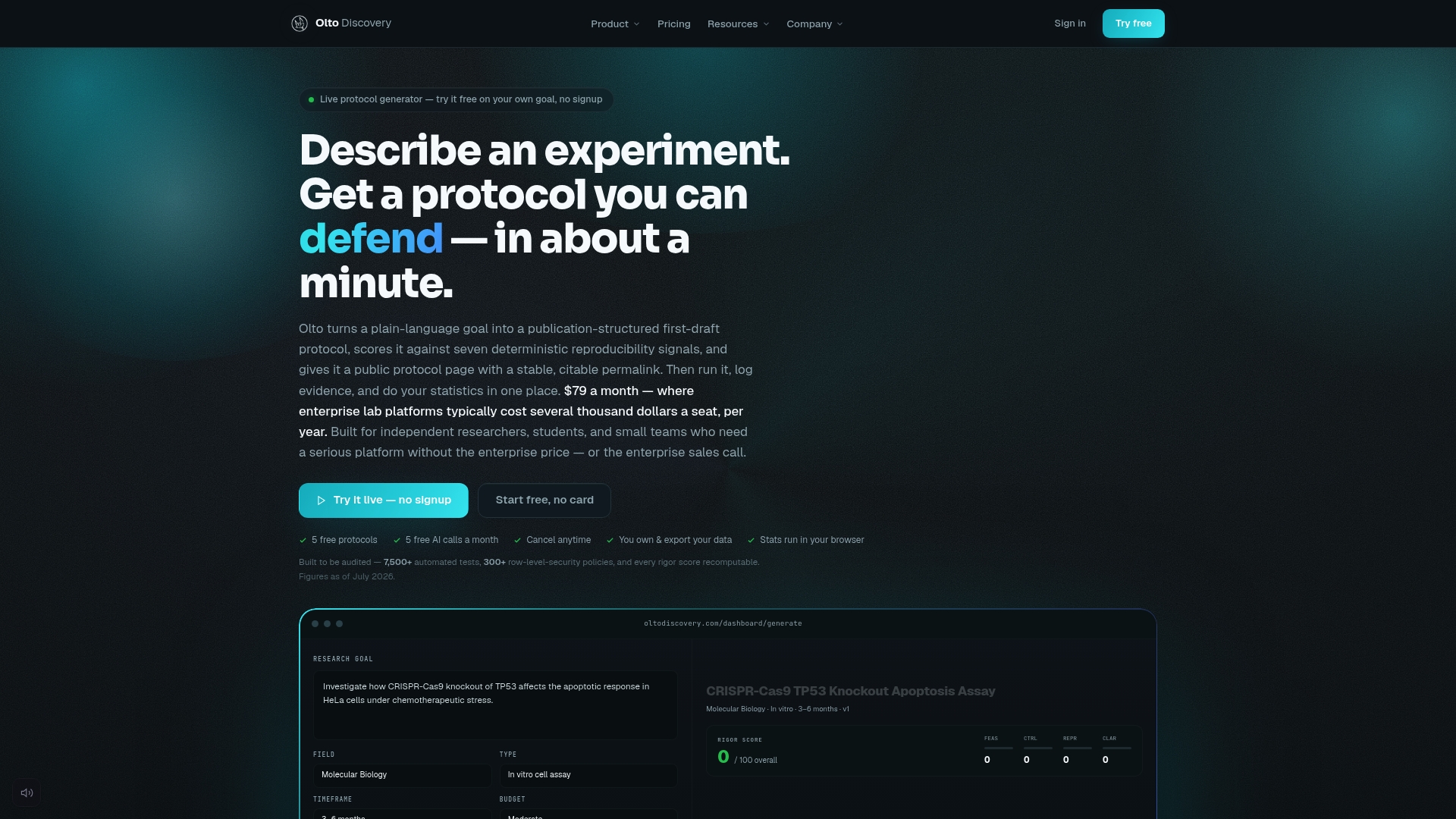
The platform generates structured, publication-ready protocols from plain-language research goals, assigns deterministic reproducibility scores, and issues public Reproducibility Passports that serve as verifiable experiment identities. For teams with compliance obligations, content-addressed protocol fingerprints and immutable audit logs provide the traceability evidence that ISO 17025 and 21 CFR Part 11 inspections require, without the consulting overhead of an enterprise deployment.
Key capabilities relevant to the ELN vs LIMS decision:
- Structured protocols linked to sample and reagent metadata
- Inventory and reagent tracking with lot-level records
- Immutable audit trail and reproducibility fingerprints for every experiment
- Browser-based statistical analysis and computational notebooks
- Real-time team collaboration with role-based access
Pricing is transparent and tiered by individual, team, and enterprise plans. Try the AI protocol generator free to see how quickly a structured, traceable experiment record comes together, or review the full plan comparison to find the tier that fits your team's scale.
Useful sources for further reading
The sources below are the most useful for validating procurement decisions, understanding standards requirements, and evaluating vendor claims.
| Source | Best used for |
|---|---|
| Lab Thread: Do I need an ELN, a LIMS, or both? | Decision framework, integration red flags, and vendor evaluation questions |
| Lab Software Guide: ELN vs LIMS | Feature comparison and implementation timeline benchmarks |
| SCC Soft Computer: Disadvantages of LIMS | Understanding LIMS cost and complexity risks before procurement |
| Lab Trace: LIMS for small ISO 17025 labs | SaaS procurement guidance and audit-readiness for smaller labs |
| Technology Networks: ELN, LIMS, CDS, LES differences | Understanding adjacent system types (LES, CDS) and where they fit |
| Labtag Blog: ELN vs LIMS key differences | Practical feature-level comparison for procurement teams |
| Wikipedia: Laboratory information management system | Background definitions and historical context |
| Oltodiscovery: Reproducibility Fingerprint specification | Technical validation artifacts for reproducibility and audit evidence |
| Oltodiscovery: Public protocol library | Example structured protocols demonstrating integrated ELN+LIMS workflows |
| Oltodiscovery: Education Trust Center | Compliance and audit-grade traceability documentation for academic labs |
This article provides general informational guidance on laboratory software categories. Specific compliance requirements under 21 CFR Part 11, ISO 17025, or other standards vary by lab type, jurisdiction, and accreditation body. Confirm current requirements with the relevant regulatory authority or a qualified compliance professional before making procurement decisions.