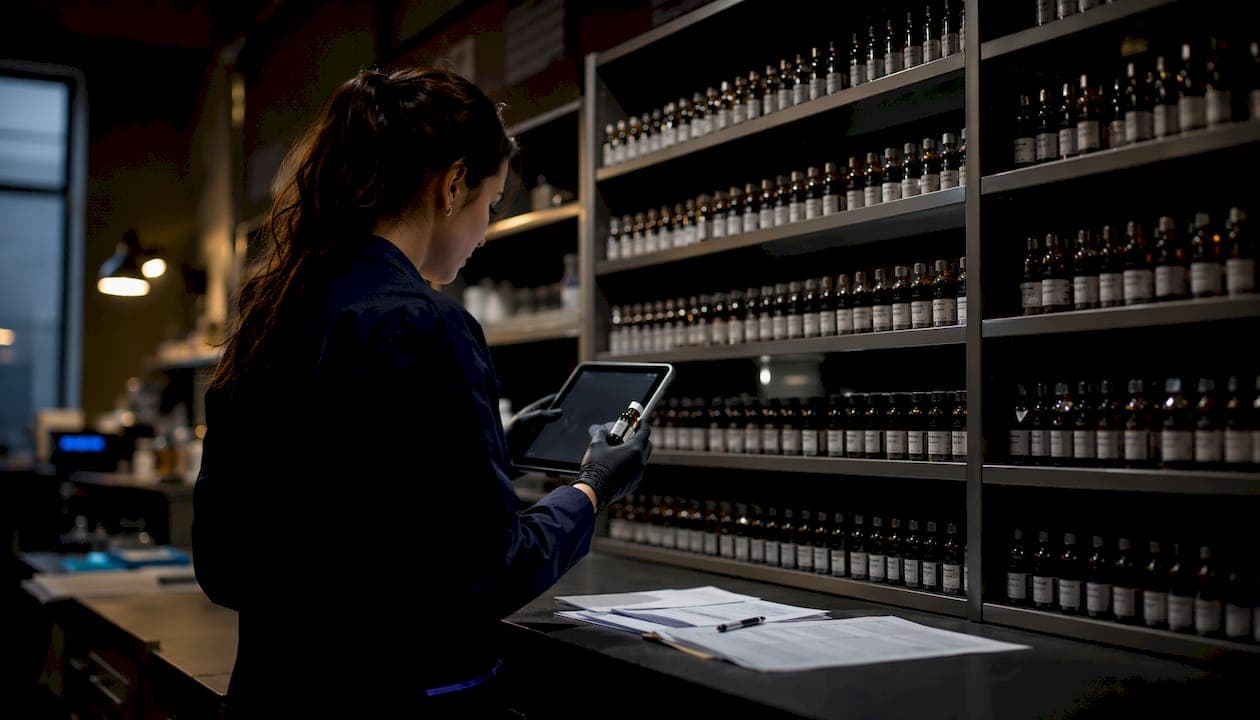
Lot number tracking means recording every reagent lot and linking it to receiving metadata, storage conditions, verification results, and the experimental protocols it supports. When a new lot arrives, quarantine it immediately, capture the required fields, run verification tests with representative samples, and release it only after it meets your pre-defined acceptance criteria.
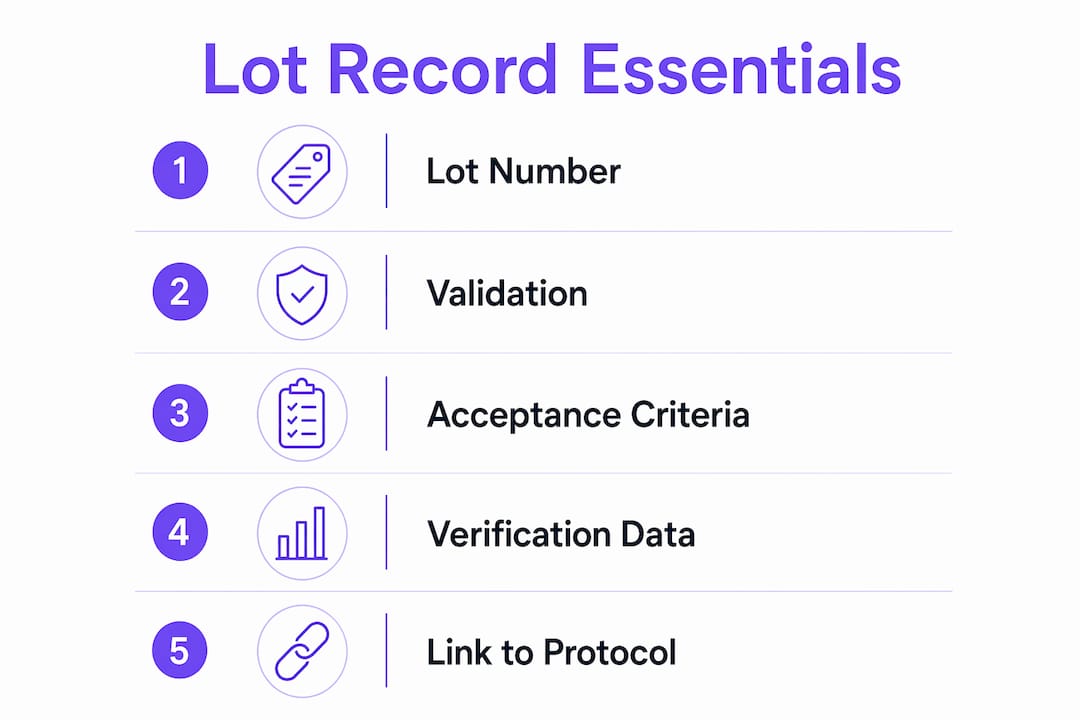
Minimum fields for audit readiness:
- Lot number and catalog number
- Manufacturer and supplier name
- Date received and received-by (name/ID)
- Expiration date and storage conditions (temperature, location)
- QC/verification results and acceptance decision
- Verifier name and verification date
- Linked protocol IDs and run IDs
- Disposal or recall notes
Table of Contents
- Why lot number tracking matters for scientific validity and compliance
- What records every lot file must contain
- How to verify a new reagent lot before releasing it for use
- How continuous monitoring catches cumulative drift that single checks miss
- SOPs, change control, and chain-of-custody practices that make lot tracking enforceable
- Spreadsheets, LIMS, or integrated platforms: which fits your lab?
- US audit readiness: a CLIA-aware checklist for lot verification records
- Common pitfalls in lot tracking and how to fix them
- Key Takeaways
- The case for treating lot tracking as a reproducibility practice, not a compliance chore
- Oltodiscovery brings lot tracking and protocol reproducibility into one place
- Useful sources for deeper reading
Why lot number tracking matters for scientific validity and compliance
Lot-to-lot variability is a documented source of analytical error with real consequences for experimental conclusions. Antibody batches, calibrators, and enzymatic reagents can shift in binding affinity, activity, or concentration between production runs. Immunoassays are particularly vulnerable because the critical quality attributes of antibodies and calibrators are difficult to hold constant across manufacturing cycles. A single undetected lot shift can bias an entire data set without triggering a conventional QC flag.
CLIA '88 and accreditation checklists require US laboratories to document validation of new reagent lots and demonstrate that lot changes do not affect reported results. For research labs that feed clinical decisions or regulatory submissions, that expectation is effectively non-negotiable. Even labs outside direct CLIA scope benefit from the same discipline: without traceable lot records, re-analyzing experiments after a manufacturer recall becomes guesswork.
Pro Tip: Set your acceptance criteria before you open the new lot, not after you see the data. Post-hoc criteria are a red flag in any audit.
What records every lot file must contain
The table below covers mandatory fields and the optional additions that meaningfully strengthen traceability.
| Field | Required / Optional | Notes |
|---|---|---|
| Lot number | Required | Copy exactly from label; scan barcode when possible |
| Catalog number | Required | Links lot to product specification |
| Manufacturer | Required | Full legal name, not abbreviation |
| Supplier | Required | Distributor if different from manufacturer |
| Date received | Required | Date shipment arrived, not order date |
| Received by | Required | Name or employee ID |
| Expiration date | Required | From label; flag if absent |
| Storage conditions | Required | Temperature range and physical location |
| QC/verification results | Required | Numerical results, not just pass/fail |
| Acceptance decision | Required | Pass, marginal, or fail with rationale |
| Verifier name and date | Required | Signature or authenticated login |
| Linked protocol IDs | Required | Every protocol using this lot |
| Disposal/recall notes | Required | Date, reason, and outcome |
| Shipping temperature log | Optional | Especially for cold-chain reagents |
| Certificate of analysis (COA) | Optional | Attach PDF; record document ID |
| Vendor lot-release data | Optional | Manufacturer's internal QC specs if shared |
| Chain-of-custody signatures | Optional | Useful for GLP or regulated workflows |
Naming conventions matter. Use a consistent lot ID format across your LIMS or spreadsheet so records can be joined to experimental metadata by a simple key. A format like {CatalogNum}_{LotNum}_{YYYYMMDD} is unambiguous and sortable.
How to verify a new reagent lot before releasing it for use
-
Quarantine and capture metadata. Place the new lot in a designated quarantine area. Record all required fields immediately, attach the COA, and log the shipment temperature if the reagent is cold-chain.
-
Select representative samples. Use native or experimental samples that span the decision limits relevant to your assay, not only commercial QC materials. Standard QC materials may lack commutability, meaning they can pass verification while native samples behave differently. For critical assays, include samples near clinically or experimentally meaningful thresholds. See the controls design guide for practical guidance on selecting representative materials.
-
Design the comparison run. Determine sample count, replicates, and statistical power targets in advance, drawing on CLSI EP26 considerations. Real-world labs often adapt sample counts because strict tables can demand impractically large sets; document whatever adaptation you make and justify it. Run the new lot in parallel with the current lot or a reference standard.
-
Apply total allowable error, not an arbitrary percentage. Acceptance limits should reflect the total allowable error or the scientifically meaningful decision limit for the analyte. Arbitrary percentage-based cutoffs are discouraged because they ignore the clinical or experimental context of the measurement.
-
Make the acceptance decision. Three outcomes are possible:
- Pass: release the lot, update the lot record, label storage, and link the lot to affected protocols.
- Marginal: expand the sample set if feasible, document the exact acceptance rules applied, and notify the manufacturer with your data.
- Fail: contact the manufacturer to request an alternate lot, document all correspondence, and log any mitigation steps (mathematical correction, referral) to enable retrospective re-analysis if needed.
-
Release and label. Affix a lot-specific label to the storage container, update the inventory record to "released," and notify all team members whose protocols are affected.
How continuous monitoring catches cumulative drift that single checks miss
A one-time verification at lot receipt confirms the new lot is acceptable on day one. It does not catch slow, cumulative bias that builds across multiple lot changes or over months of use. Moving patient or experimental averages address this gap by tracking the mean of recent results and flagging when it drifts outside control limits.

Implementing moving averages requires per-analyte tuning: choose the window size, truncation rules (to exclude extreme values), and alert thresholds carefully. The method works well for stable analytes with consistent population distributions. It is less reliable for analytes with seasonal variation or when the sample population shifts significantly, so apply it selectively.
Low-volume labs that lack the throughput to power their own trend analysis can benefit from collaborative verification: pooling results across sites or participating in manufacturer-facilitated or external QA repositories increases statistical power to detect meaningful lot differences. Any trend alert should link back to the specific lot record so the team can assess whether a drift coincides with a lot change.
Pro Tip: Link every trend alert to its lot record in your tracking system. When drift appears, you want to answer "did this start with the new lot?" in seconds, not hours.
SOPs, change control, and chain-of-custody practices that make lot tracking enforceable
Good records are only as reliable as the procedures that generate them. A working SOP for lot tracking should cover:
- Roles: who receives shipments, who runs verification, and who serves as QA lead for the acceptance decision
- Required documentation steps: fields to complete at receipt, during verification, and at release or rejection
- Retention policy: how long lot records are kept and in what format (paper, electronic, or both)
- Escalation path: what happens when a lot fails, including manufacturer contact and team notification
Change control is equally important. When a lot change affects a protocol, update the protocol version, record the change in the protocol metadata, and communicate it to everyone running that assay. Versioned SOPs with approval gates prevent teams from unknowingly using outdated procedures after a lot transition.
Training records should document who received and verified each lot, with timestamps. Include those records in your audit packet alongside the verification run data.
Spreadsheets, LIMS, or integrated platforms: which fits your lab?
The right tool depends on your lab's volume, risk profile, and existing infrastructure.
| Approach | Best for | Key limitation | Essential features to add |
|---|---|---|---|
| Spreadsheet | Very low volume, low-risk assays | Manual entry errors, no automated alerts, poor protocol linking | Strict naming conventions, locked templates |
| Standalone LIMS | Mid-to-large labs with IT support | Can be costly; may not link lots to protocol metadata natively | Barcode scanning, COA attachments, audit export |
| Integrated reproducibility platform | Teams prioritizing protocol linkage and audit-ready exports | Requires migration from existing tools | Lot metadata, trend alerts, reproducibility passports |
Automation via barcodes or RFID reduces human error compared with manual spreadsheet entry. For labs running critical assays, the minimum feature set to look for includes: lot metadata capture, barcode sample tracking, COA attachment storage, protocol linking, audit export, and automated alerts for trend drift.
Oltodiscovery supports this workflow directly. Its inventory and reagent tracking links lot metadata to protocol steps and reproducibility passports, so every experiment carries a traceable record of which lot was used and what the verification data showed. The protocol library includes examples of lot-linked workflows across assay types. For rollout, pilot with one or two high-risk assays first before migrating the full inventory.
US audit readiness: a CLIA-aware checklist for lot verification records
Before any audit, confirm your lot file contains: a complete receipt record with all mandatory fields; the verification run data with raw results (not just a pass/fail summary); documented acceptance criteria set before the run; the verifier's name, credentials, and sign-off date; any manufacturer correspondence for marginal or failed lots; and a clear link from the lot record to every protocol and result set that used it. For recalls, retain the manufacturer notification, your retrospective re-analysis plan, and the outcome. CLIA-relevant guidance expects this chain to be reconstructable on demand.
When presenting an audit packet, organize it as: (1) the lot receipt record, (2) the verification run summary with acceptance criteria, (3) the decision rationale, and (4) any manufacturer correspondence. If a manufacturer later flags a lot, your documented mitigation steps and manufacturer communication records are what make retrospective re-analysis possible.
This article is general informational guidance, not legal or regulatory advice. Confirm current CLIA requirements and accreditation standards with CMS, your accrediting body, or a qualified compliance professional for your specific situation.
Common pitfalls in lot tracking and how to fix them
- Relying only on non-commutable QC materials. Fix: always include native or representative experimental samples for critical assays, especially immunoassays.
- Inconsistent lot naming. Fix: enforce a single naming convention in your LIMS or template; reject records that deviate.
- Failing to link lots to protocols and results. Fix: make protocol ID a required field at lot release; no link, no release.
- Delayed verification. Fix: automate receipt capture with barcode scanning so the lot record opens the moment the shipment is scanned in.
- Ignoring cumulative drift. Fix: implement moving averages on your two or three highest-risk analytes and set automated alerts tied to lot records.
- No escalation documentation. Fix: when you contact a manufacturer about a failed or marginal lot, log the date, contact name, your data, and their response in the lot file.
Pro Tip: When escalating to a manufacturer, send your raw verification data, not just a summary. Manufacturers can only investigate meaningfully if they see the actual numbers.
Key Takeaways
Rigorous lot number tracking requires quarantining new lots on arrival, capturing a defined set of metadata fields, verifying with representative native samples against pre-set acceptance criteria, and linking every lot record to the protocols and results it supports.
| Point | Details |
|---|---|
| Quarantine first, verify before use | Isolate every new lot on arrival and complete all required fields before running any experiments. |
| Use native samples for verification | Non-commutable QC materials can pass while native samples fail; include representative experimental samples for critical assays. |
| Set acceptance criteria in advance | Base limits on total allowable error or scientific decision limits, not arbitrary percentages. |
| Monitor continuously for cumulative drift | Moving averages on high-risk analytes catch slow bias that single lot-change checks miss. |
| Oltodiscovery links lots to protocols | The platform connects lot metadata, verification data, and reproducibility passports to every protocol and result for audit-ready traceability. |
The case for treating lot tracking as a reproducibility practice, not a compliance chore
Most labs treat lot tracking as a box to check before an audit. That framing is the wrong one. The real cost of poor lot records shows up months later, when a result looks anomalous and no one can determine whether the shift came from the biology, the reagent, or a cumulative drift across three lot changes. Structured tracking is what lets you answer that question in an afternoon rather than a week.
The labs that handle this well share one habit: they link lot records to protocols at the moment of release, not retroactively. That single discipline, consistently applied, is what makes reproducibility passports meaningful rather than decorative. A reproducibility passport is only as credible as the lot data behind it.
Start with the minimum checklist in this guide. Pilot a platform on your two highest-risk assays. The infrastructure investment is small; the diagnostic value when something goes wrong is not.
Oltodiscovery brings lot tracking and protocol reproducibility into one place
Lot records scattered across spreadsheets and disconnected from your protocols create exactly the audit gap this guide describes. Oltodiscovery closes it by connecting inventory and reagent lot metadata directly to protocol steps, verification runs, and public reproducibility passports, so every experiment carries a traceable record without manual re-entry.
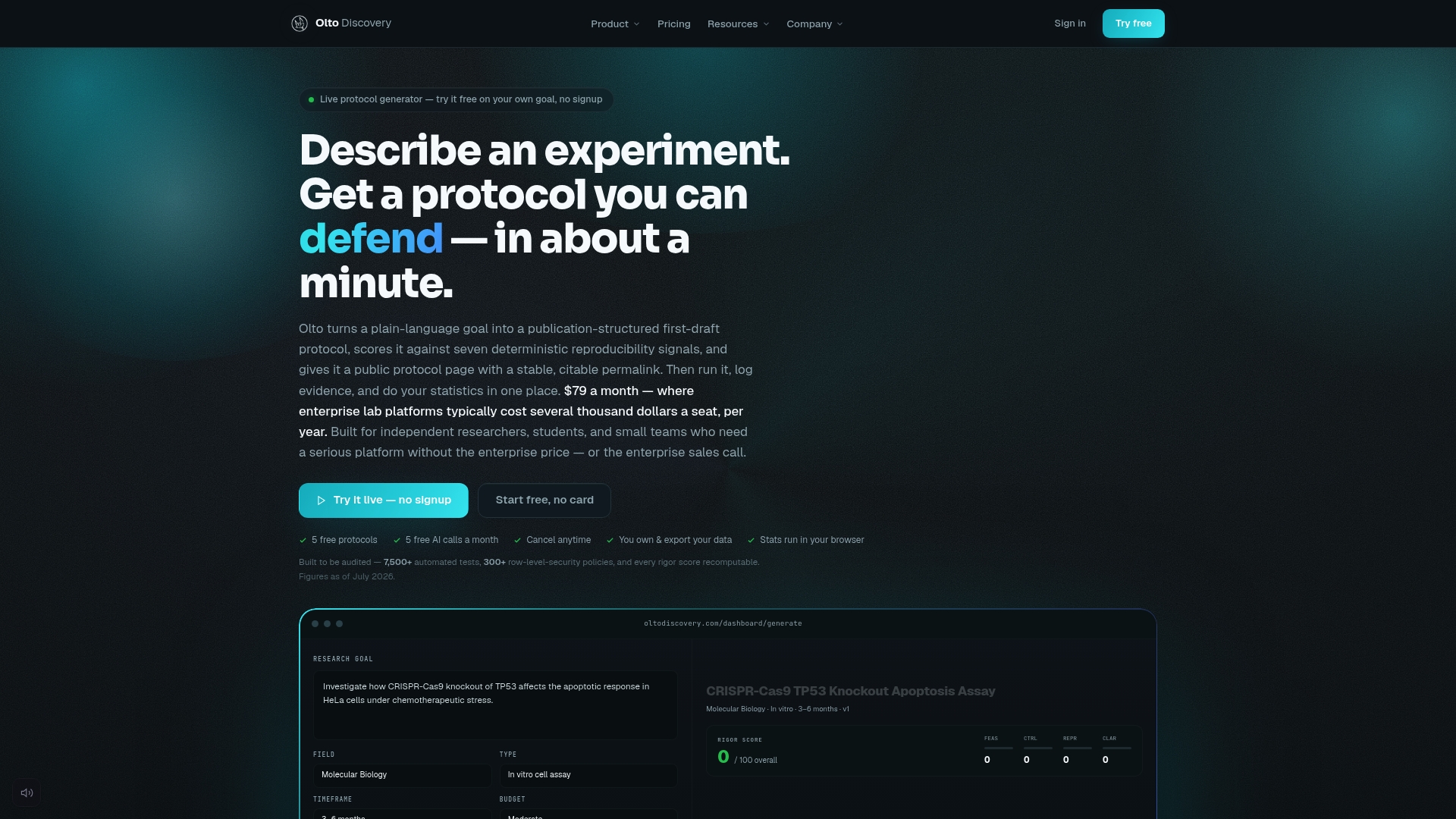
The platform supports barcode-driven receipt capture, COA attachments, protocol linking, and audit-ready export, covering the full feature set outlined in the tools section above. For teams ready to move beyond spreadsheets, the practical starting point is a pilot on one or two high-risk assays: generate a protocol, attach the lot record, and export the verification summary. Pricing tiers cover individual researchers through enterprise teams, with a free trial available.
Try Oltodiscovery free to run your first lot-linked protocol, or browse the open protocol library for verified workflow examples across assay types.
Useful sources for deeper reading
- Lot-to-lot variation: quantification and implications — Open-access review covering statistical frameworks (including CLSI EP26 considerations), moving-average monitoring, and acceptance-criteria guidance; the primary reference for verification design.
- Lot-to-lot variance in immunoassays: causes, consequences, and solutions — Explains the biological and manufacturing sources of immunoassay LTLV; essential reading for labs running antibody-based assays.
- Managing reagent lot-to-lot variability (ADLM) — Practical guidance on CLIA expectations, native-sample verification, escalation to manufacturers, and documentation for retrospective re-analysis.
- Lot-to-lot variation and verification (De Gruyter/CCLM) — Covers collaborative verification approaches and manufacturer communication practices; useful for low-volume labs and multi-site teams.
Always attach the manufacturer's COA to each lot record and retain it for the duration of your data retention policy. COAs are the first document an auditor or collaborator will request when a lot is questioned.